
What's next at UVA's High-Performance Computing, AI Book Launch, and UVA AI Program Deadlines [2026.16]
Our mission is simple: to keep the UVA community informed, engaged, and inspired as we navigate this transformation together.

UVA’s AI Resources: High-performance computing [Podcast]


UVA is transforming research by making advanced AI and computational tools easily accessible to faculty, guided by two world-class on-campus experts: Dr. Josh Baller and Dr. Jackie Huband. Dr. Baller, the Associate Vice President for Research Computing, brings a diverse research background spanning mathematics and genetics. Dr. Huband, who directs the Data Analytics Center, leverages her extensive experience as both a former defense contractor programmer and a tenured computer science faculty member.
Crucially, the majority of these computational resources are provided at no cost to university Principal Investigators. To keep up with the explosive demand for AI processing, UVA will soon begin construction of a 16-megawatt data center at the Fontaine Research Park. Slated to come online in January 2029, this data center will be a unique capability for UVA among its peers.
Together, their teams are accelerating projects across the university:
Data Analytics Center (DAC): Led by Dr. Huband, this team is comprised of computational experts who help faculty match the right tools—from deep learning to LLMs—to specific research questions, assisting with coding and technical implementation across all disciplines. More information: https://www.rc.virginia.edu/service/dac/
High Performance Computing (HPC): This unit of Research Computing provides secure, on-premises computing that is up to 80 times cheaper than proprietary cloud APIs. They also recently launched a user-friendly LLM API endpoint and web interface so researchers can easily access open-source models without worrying about token limits. More information: https://www.rc.virginia.edu/
UVA AI Book Launch - Mona Sloane
How AI is rewiring our social fabric—and how we can better shape our future.


The age of AI is not what you think. Rather than ushering in a fourth Industrial Revolution, AI has become a crucial social infrastructure of everyday life. It’s embedded in the tools, platforms, and systems that organize our most intimate lives and our interactions with the most fundamental institutions of society, from government agencies to banks and schools. In these linkages are embedded assumptions about who we are, what we can do, and where we belong.
In Predicted, Mona Sloane offers a pragmatic framework for understanding these transformations around prediction, classification, and linearity, proposing that we think about AI as a social arrangement that we coproduce. Drawing on over a decade of empirical research and real-world examples, this book invites us to see AI for what it is: deeply social, deeply political, and open to change. Clear-eyed and provocative, Predicted is a call to reclaim deliberations about progress and innovation as a public good and to ensure that the futures we chart are the ones we choose—together.
About the Author
Sociologist Mona Sloane is Assistant Professor of Data Science and Media Studies at the University of Virginia. She leads the Sloane Lab, convenes the Co-Opting AI public speaker series, and is Technology Editor at Public Books.
Looking for a powerful and free (for UVA) LLM?
Now available from UVA Research Computing is UVA RC GenAI, a high‑powered generative AI platform running on Kimi K2.5, an open-source, 1-trillion parameter multimodal model well suited for visual analysis, agentic applications, and code‑based tasks. Open to Research Computing users, the tool runs on eight NVIDIA H200 graphics processing units (GPUs) and allows researchers to submit up to 60 queries per minute at no charge.
Compared to commercial tools or other large language models built for specific research tasks, UVA RC GenAI offers reduced costs, enhanced data security, operational efficiency, and clear institutional ownership.
Within Research Computing’s Afton and Rivanna systems, researchers can access UVA RC GenAI via a web portal and application programming interface (API). The web portal interface resembles familiar AI chatbots, allowing users to submit questions or requests in natural language and receive responses generated from the model’s trained data. API access supports more advanced use cases, including complex analyses and large-scale or automated workflows.
Access UVA RC GenAI: https://open-webui.rc.virginia.edu
Access the user guide: UVA RC GenAI Users Guide
Summer 2026: AI Opportunities for UVA Faculty
Two deadlines first, since they’re close. The AI Catalyst Program needs your proposal to your dean’s office by May 30. The Microsoft Research “AI and the New Future of Work” CFP closes May 25. Details on both below, along with the summer workshop schedule and a self-paced option.
UVA Faculty Live workshops (June and July)
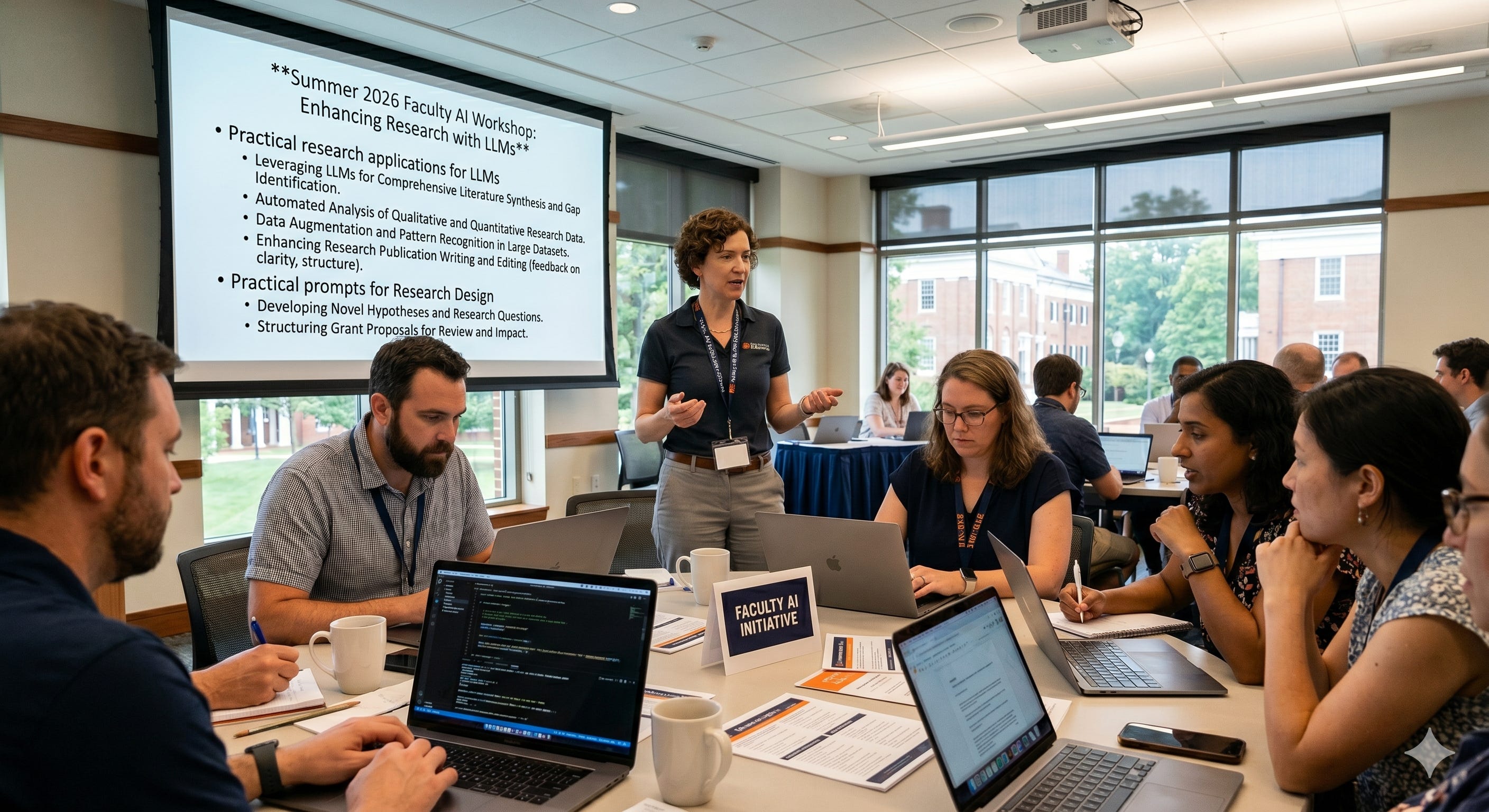
The AI Research Initiative is running seven hands-on sessions for faculty, researchers, and graduate students. Most run noon to 1:00 in Shumway Hall; two are extended. Attend in person or join by Zoom.
Friday, June 5, 12:00–2:30 — Agentic Workflows in Practice (extended)
Wednesday, June 10, 12:00–1:00 — Your First API Call: Scaling AI on UVA HPC
Tuesday, June 23, 12:00–1:00 — Smarter Literature Reviews with AI-Powered Tools
Tuesday, June 23, 12:00–1:00 — Converting Large-Scale Text into Analyzable Data
Wednesday, July 15, 12:00–1:00 — Vibe Coding: Rapid Research Prototyping with AI
Thursday, July 23, 12:00–1:00 — Making AI Work Legible: Transparency, Reproducibility, and Trust
Wednesday, July 29, 12:00–2:00 — AI-Enhanced Literature Reviews: Tools & Guardrails (advanced, in-person only)
Register on Eventbrite: https://www.eventbrite.com/organizations/events
UVA Self-paced learning: AI Lit Review
For something you can use right now, the UVA Library has a writeup on Consensus, an AI-powered academic search tool licensed for the whole university. Consensus only returns real papers because it searches the literature first and then summarizes; it can’t fabricate citations the way general-purpose chatbots can.
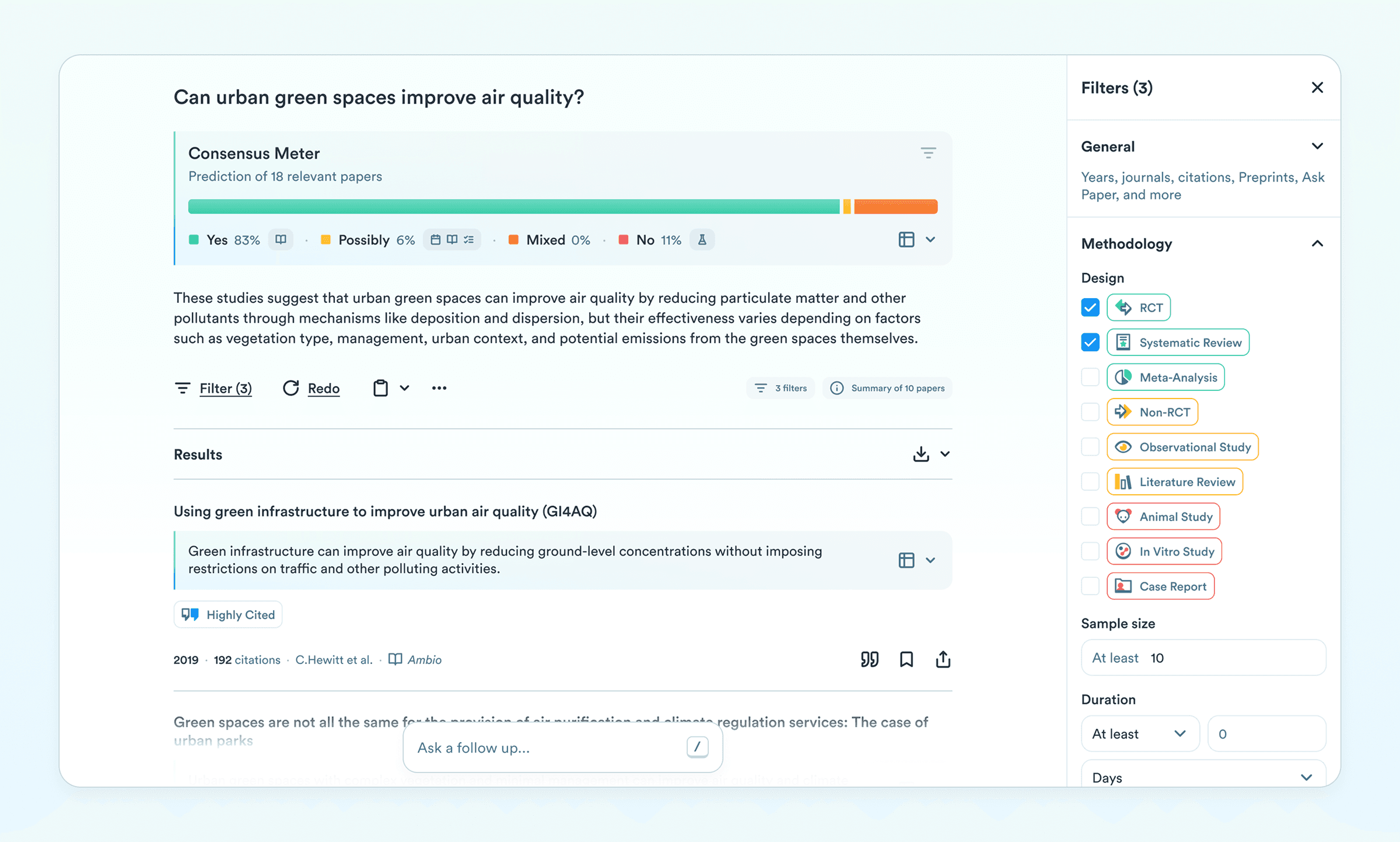
Sign up with your UVA email for unlimited Pro searches and 50 Deep searches a month.
Jenn Huck’s piece: To Avoid AI Hallucinations, Try Consensus
UVA AI Catalyst Program (proposals due May 30)
A year-long cohort experience for tenured and tenure-eligible faculty with a specific research project that would benefit from AI, but needs additional skills, coaching, or technical infrastructure to advance.
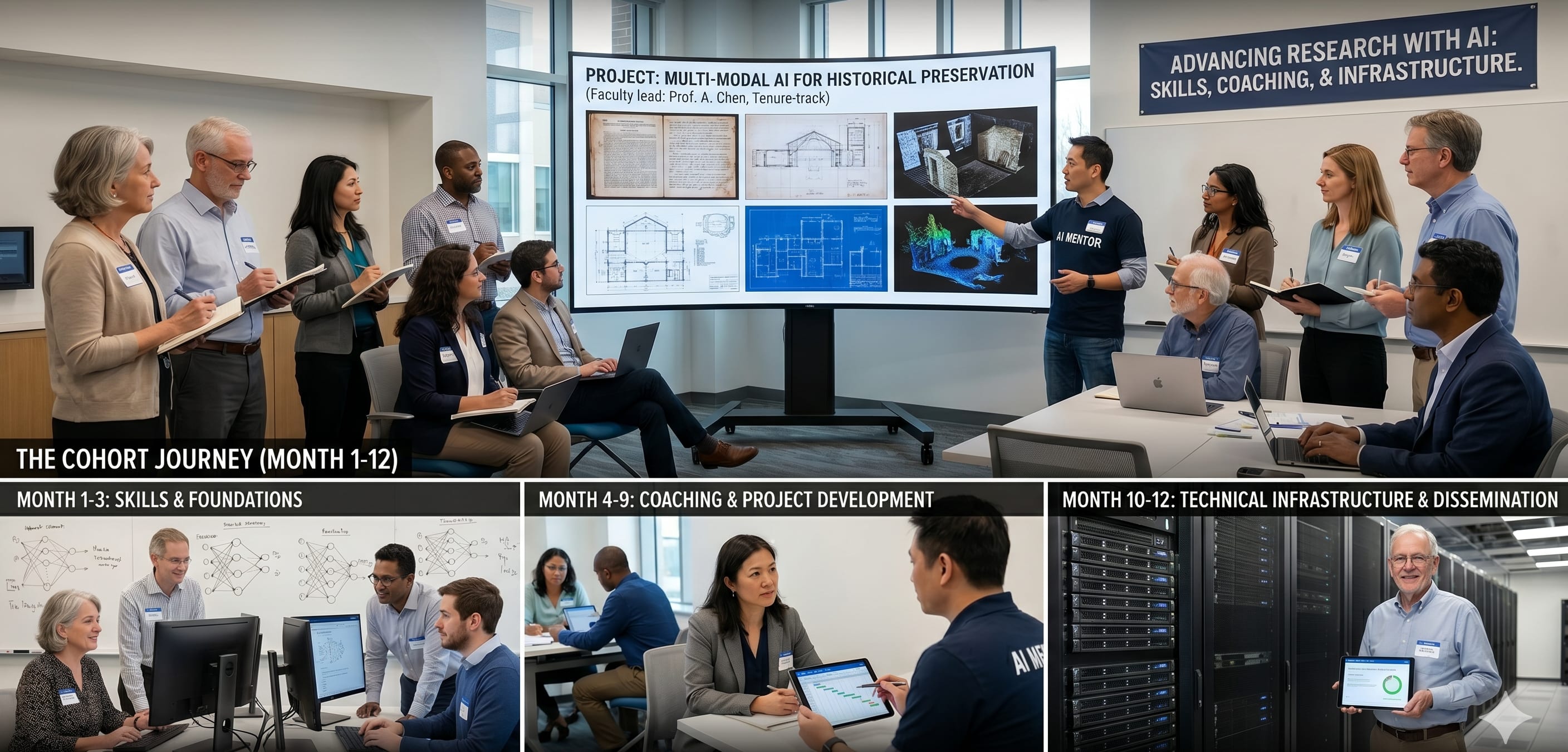
Participants receive:
Up to $10,000 in discretionary research funding
Mentoring on learning objectives and research design
Priority access to the Data Analytics Center
Three cohort gatherings per semester (training, speakers, collaboration)
A capstone showcase in August 2027
The 2025–26 cohort is working on missing-data imputation in longitudinal studies, AI-driven Higgs boson detection, transcription of 1.4 million BIA index cards for indigenous land policy research, ESG language shifts in mutual fund disclosures, and several others. Up to 15 spots, drawn from across Grounds.
Submissions route through your dean’s office. Each school forwards up to five proposals to the AI Research Institute by May 15; decisions arrive June 15, and the program runs August 2026 through August 2027.
Details and application: https://ai.provost.virginia.edu/ai-upskilling
Grant opportunity: Microsoft Research, “AI and the New Future of Work” (proposals due May 25)

Microsoft is funding research on how teams, not just individuals, work with AI. Awards run $50K–$75K USD as unrestricted gifts. The proposal is short: 500 words plus references, one page total.
Topics of interest include systems where teams with AI substantially outperform individuals with AI, simulation environments for training collaborative AI, communication overload at work, AI proactivity in group conversations, and norms for teams with AI deeply embedded in their work.
Proposals due Monday, May 25 at 11:59 pm Pacific. Decisions go out the week of June 8.
Full call: AI and the New Future of Work CFP, Spring 2026
Keep up with AI events at UVA
The AI Research Initiative maintains a running calendar of talks, workshops, and seminars across Grounds. Have an AI-related event of your own? Send it our way and we’ll add it to the calendar.
Calendar and event submissions: https://ai.provost.virginia.edu/events
2nd Annual Cosmic Horizons Conference
🗓 July 13 - 26, 2026| Charlottesville, VA
The NSF-Simons AI Institute for Cosmic Origins (CosmicAI) is excited to announce the 2nd Annual Cosmic Horizons Conference hosted by the NSF National Radio Astronomy Observaotry (NRAO).
The recent revolution in AI is fundamentally changing how astronomers observe, explore, analyze, and model astronomical data. The Cosmic Horizons Conference aims to bring together researchers who are actively developing and applying AI/ML methods in astronomy.
UVA AI Resources
AI in the Curriculum Playbook: A practical framework for intentionally embedding AI capabilities into any program or course.
AI for Academic Excellence - Student Toolkit: A comprehensive guide for students on the best uses of AI.
AI Agents in Economic Research (Anton Korinek): A guide for researchers on the use of AI agents.
UVA Claude Builders Student Club: A 250+ strong group for those interested in development via Claude.
UVa AIML Seminar - Seminar featuring artificial intelligence, machine learning, and their applications.
UVA Podcasts We Listen to
Co-Opting AI: Public Conversations About Artificial Intelligence and Society:
Prof. Mona Sloane’s series Co-Opting AI is a virtual public speaker series that interrogates and demystifies AI.UVA Data Points: Podcast from the School of Data Science.
HOOS in STEM: From Prof. Ken Ono this series showcases the marvelous cornucopia of STEM at UVA, from the latest innovations to growth inside and outside the classroom.
Thanks for reading AI @ UVA Substack! Subscribe for new posts and podcasts.