
AI Exchange @ UVA [2026.9]
Our mission is simple: to keep the UVA community informed, engaged, and inspired as we navigate this transformation together.


A Practical Guide for Embedding AI in Any Curriculum
“We know AI is changing our field. We don’t know what to do about the curriculum.”
– Anonymous Department Chair
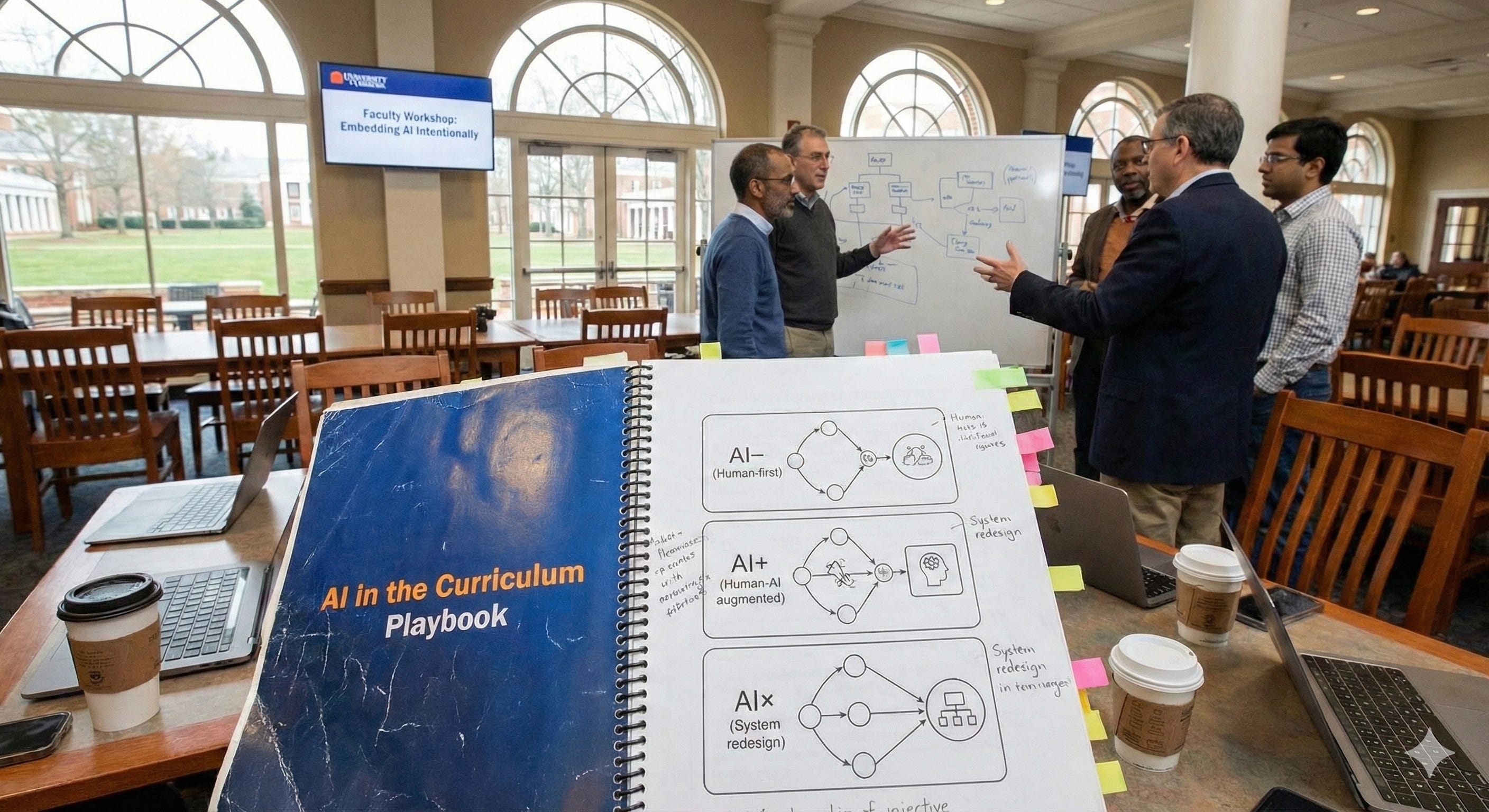
Today, we are releasing the AI in the Curriculum Playbook. A practical framework for embedding AI capabilities intentionally into any program or course.
The core idea
The playbook builds on Greg Niemeyer’s (Cal-Berkeley) pedagogical framework, distinguishing three roles for AI in learning:
AI− (Minus): Human-first. Build foundational capability without AI assistance.
AI+ (Plus): Human-AI augmented. Use AI transparently while critiquing and verifying outputs.
AI× (Times): System redesign. Design and govern AI-enabled workflows.
These are design choices, not maturity levels. Most curricula should use all three… intentionally.
What’s in it
Seven modules with worksheets: shared language, capability definition, topic inventory, prioritization, vertical progression, course-level calibration, and employer validation. Plus ready-to-adapt syllabus language and a 2-hour workshop agenda.
The goal isn’t to add AI everywhere. It’s to place AI intentionally so learning stays rigorous and graduates remain job-relevant.
If you use it with your faculty, I’d welcome your feedback.
AI Predictions
We’re launching the first edition of our AI Predictions series this week. The objective is to spotlight UVA and UVA-connected experts as they share their forecasts for what’s ahead in AI in 2026.
“AI did the Science” - Ken Ono
Ken Ono is an American mathematician with fields of study in number theory. Formerly the STEM Advisor to the Provost and the Marvin Rosenblum Professor of Mathematics at the University of Virginia, he now works in artificial intelligence at Axiom Math in Palo Alto, California.
“AI will changes how organizations operate.” - Ryan Nelson
Ryan Nelson is the founding Director of the Center for the Management of Information Technology, a role he has held since CMIT's inception in 1991. His research focuses on digital product management, innovation, and IT project management. He received an All-University Teaching Award from the University of Virginia in 2014 and the Faculty Recognition Award from The Order of Claw & Dagger in 2022.
More AI predictions to come from Scott Acton, Jingjing Li, Reza Mousavi, Jill Mitchell, Marc Santgini, Mark Outten, Raj Venkatesan, Mona Sloane, Kemo Jonas, Peter Youngs….
🚀 State of AI in the Commonwealth Report: Launching Feb. 19th
Preview of AI Research Analysis Section
Our analysis of all papers with AI from 2020-2025 as a topic from arxiv.org suggested that the “Scientific Migration” has triggered a pivot.
Half of 2023’s first-time LLM paper authors came from outside NLP and traditional AI fields. Physicists, economists, biologists—everyone is getting in.
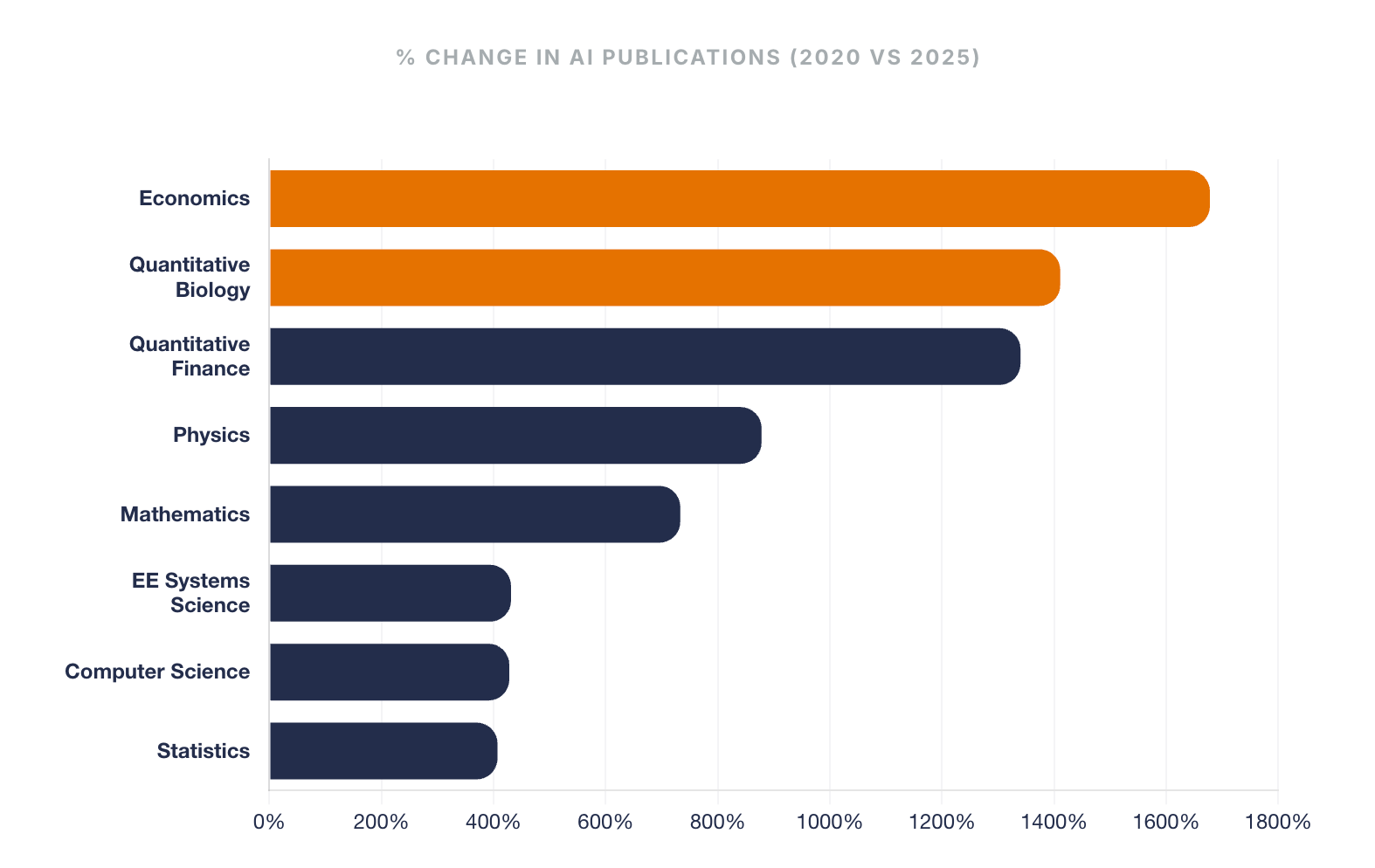
Here is the % increase in AI-related research volume since 2020:
🔹 Economics: +1,678%
🔹 Quantitative Biology: +1,411%
🔹 Quantitative Finance: +1,340%
🔹 Physics: +878%
🔹 Mathematics: +733%
🔹 EE Systems Science: +431%
🔹 Computer Science: +428%
🔹 Statistics: +407%
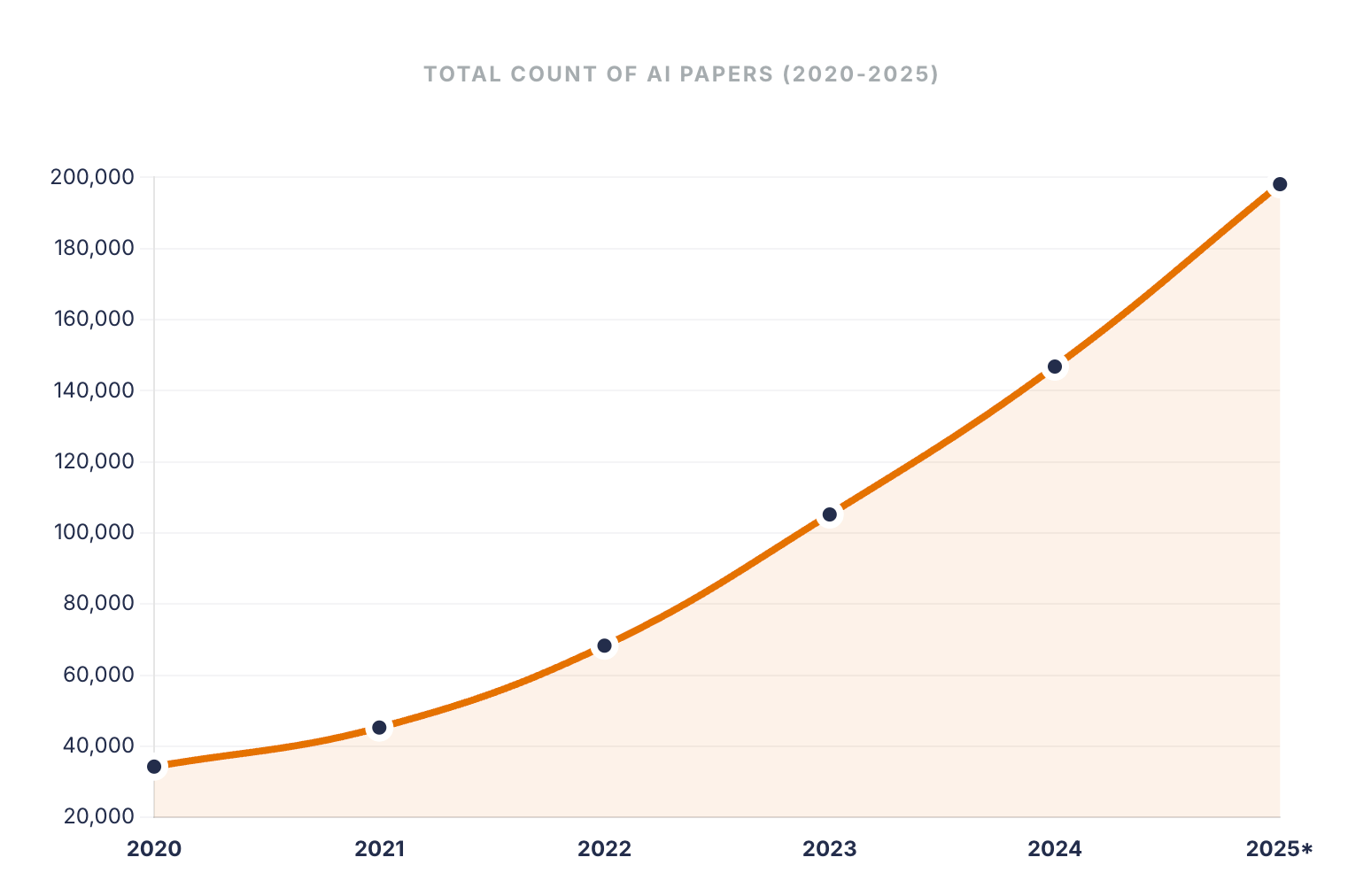
📈 The Volume Surge
Prior to 2022, AI research on arXiv followed a steady growth curve. Following model breakthroughs in late 2022, we are seeing an exponential scaling that covers all eight primary disciplines.
💡 The Big Idea
We’ve moved past the phase of “experimentation.” Fields like Economics and Quantitative Biology are scaling AI-led research at over 3x the relative velocity of core CS.
How is your industry adapting to this acceleration?
AI Research Tools
🔬 Check out Google Scholar Labs: an AI layer on top of Google Scholar. Instead of keyword matching, you ask a research question, and it identifies key topics and relationships, runs multiple search variations, and returns papers with AI-generated explanations of how each one addresses your query.
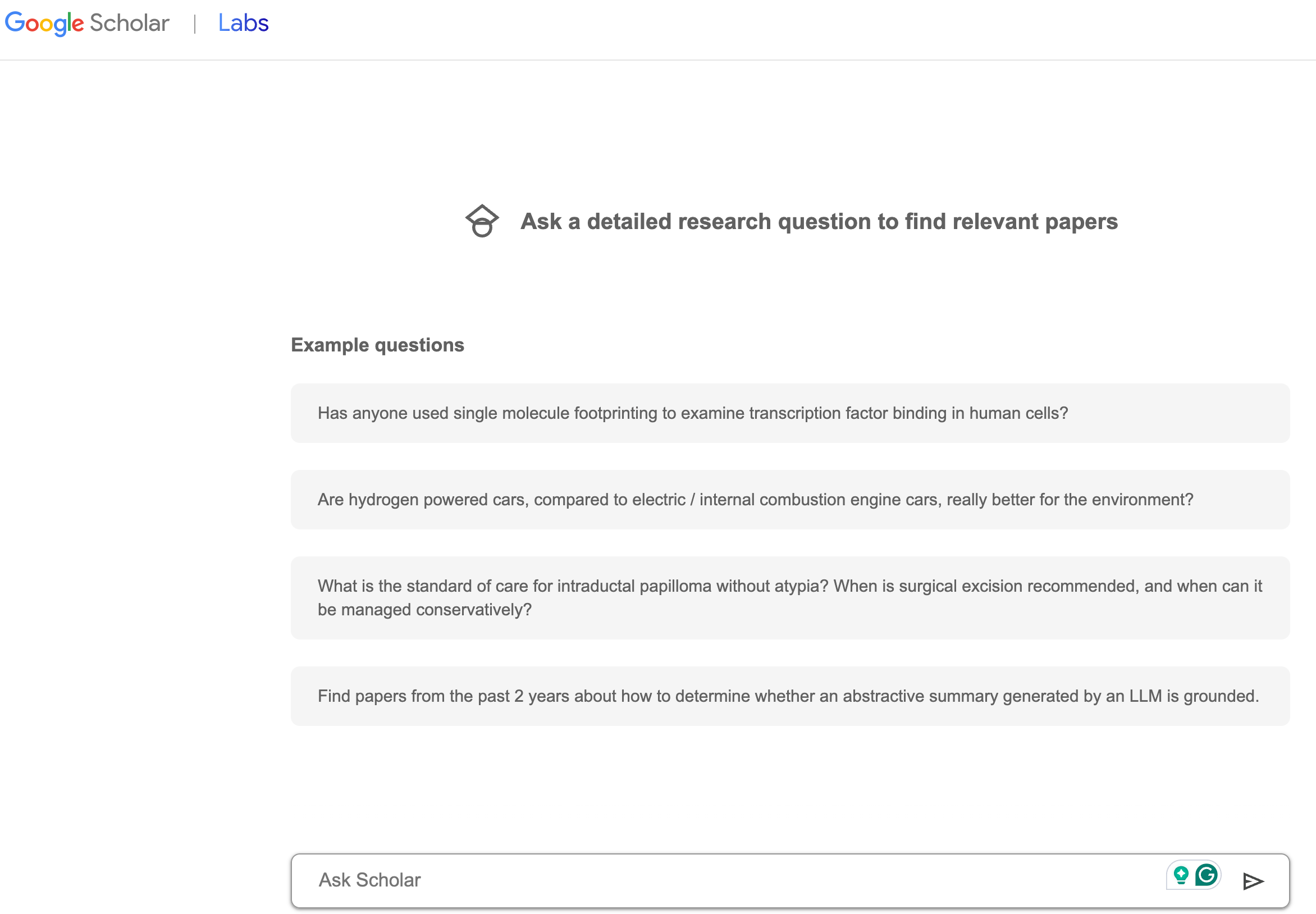
📚 Draws on Scholar’s full index (~389 million documents)—far larger than Scopus or Web of Science
🔗 Currently in limited release: scholar.google.com/scholar_labs (requires Google login)
AI Upskilling @UVA
Library Sprints — Collaborations for Research and Teaching
The University of Virginia Library invites faculty and staff to apply for Library Sprints, an intensive three to five-day program supporting research and teaching that pairs participants with teams of expert librarians, technologists, and other information specialists to advance a defined research project or pedagogical challenge. Library Sprints are designed to remove distractions, concentrate expertise, and generate tangible outcomes in a short, focused period of time.
Apply by March 2nd!
UVA Library: The Automated Scholar: Research in the Age of Powerful AI
📅 Feb 17, 11:00am to 12:00pm
🎤 Anton Korinek (Economics, University of Virginia Darden School of Business) Times 100 AI list of the most influential people in artificial intelligence
How do we build AI systems that can do serious research without losing the most important part, judgment? We will dig into verification, responsibility, and what still must remain human.
UVA Library: Practical AI Ethics
📅 Mar 18, 11:00am to 12:00pm
🎤 David Danks (Philosophy, AI, UVA School of Data Science)
A practical approach to AI ethics that yields processes and tools for designers, regulators, and users, grounded in real case studies.
AI Funding @UVA
💰 Humanities + AI Research
Schmidt Sciences’ Humanities and AI Virtual Institute (HAVI) is accepting proposals for research projects at the intersection of digital humanities and artificial intelligence.
Funding: Up to $800,000 per project
Deadline: March 13, 2026
The program supports two-way collaboration: humanities scholars applying AI tools to their research, and AI researchers gaining humanistic perspectives on data, models, and problem spaces.
Questions? Contact havi@schmidtsciences.org
💰Futures Grants Program
The Futures Grants Program provides up to $50,000 to bold, imaginative projects that pioneer solution-driven work at UVA, whether through transformative research, innovative teaching, impactful products, or new models of public engagement.
We welcome proposals addressing any challenge, with special consideration given to these themes: Education for All, Energy & Infrastructure, Life with A.I., and Sustainable Living.
Applications due (extended): Tuesday, Feb. 17, 2026
AI Events @ UVA
The Future With AI: Policies, Ethics, and Governance
🗓 February 10, 2026 | 1:00 PM–2:00 PM | Virtual
Artificial Intelligence is no longer a distant concept—it’s a prevailing force shaping nearly every aspect of our lives. Join UVA experts Renée Cummings, School of Data Science, and Mona Sloane, School of Data Science & Media Studies for a thought-provoking conversation on the policies, ethics, and governance shaping AI’s future. From cutting-edge research to innovation, this session explores how we can guide AI responsibly.
Co-Opting AI: Kids
🗓 February 11, 2026 | 4:00 PM–5:15 PM | Virtual
Kids will explore how growing up in the age of AI is reshaping children’s experiences and consider questions around agency, creativity, participation, and digital rights.
The session will be recorded for those who cannot attend live – make sure to register to receive notification when the video is available to view. Previous Co-Opting AI episodes can be found here.
Exploring the Value Chain of Ethical AI: Dive into Data Centers
🗓 February 17, 2026 | 1:00 PM–7:00 PM | Darden School
Hosted by the LaCross AI Institute, industry experts discuss data centers as critical AI infrastructure—examining rapid growth, career opportunities, and societal challenges. We will discuss the current historic growth, the professional opportunities that exist in this dynamic sector, and the business and societal challenges that must be addressed. Open to the entire UVA community.
HooHacks 2026
🗓 March 23 - 24, 2026| 24-hour hackathon
Virginia’s largest hackathon and one of the top 50 collegiate hackathons nationally. Teams compete across categories including AI/ML applications, with $10,000+ in prizes and workshops from sponsors like Google Cloud, Intel, and Capital One (Open to students 18+).
2nd Annual Cosmic Horizons Conference
🗓 July 13 - 26, 2026| Charlottesville, VA
The NSF-Simons AI Institute for Cosmic Origins (CosmicAI) is excited to announce the 2nd Annual Cosmic Horizons Conference hosted by the NSF National Radio Astronomy Observaotry (NRAO).
The recent revolution in AI is fundamentally changing how astronomers observe, explore, analyze, and model astronomical data. The Cosmic Horizons Conference aims to bring together researchers who are actively developing and applying AI/ML methods in astronomy.
Coming Soon: AI and the Environment: Seeing Impact From Both Sides
Podcast with Xi Yang, an Associate Professor in the University of Virginia’s Department of Environmental Sciences, and Lauren Bridges, an Assistant Professor in UVA’s Department of Media Studies. We will explore how AI intersects with the environment. From revealing hidden climate damage in coastal forests to examining the environmental and community impacts of data centers, their work highlights both the promise and the costs of these technologies. Together, they offer perspectives on what responsible AI research looks like as environmental challenges continue to grow.
UVA AI Resources
AI in the Curriculum Playbook: A practical framework for intentionally embedding AI capabilities into any program or course.
AI for Academic Excellence - Student Toolkit: A comprehensive guide for students on the best uses of AI.
AI Agents in Economic Research (Anton Korinek): A guide for researchers on the use of AI agents.
UVA Claude Builders Student Club: A 250+ strong group for those interested in development via Claude.
UVa AIML Seminar - Seminar featuring artificial intelligence, machine learning, and their applications.
UVA Podcasts We Listen to
Co-Opting AI: Public Conversations About Artificial Intelligence and Society:
Prof. Mona Sloane’s series Co-Opting AI is a virtual public speaker series that interrogates and demystifies AI.UVA Data Points: Podcast from the School of Data Science.
HOOS in STEM: From Prof. Ken Ono this series showcases the marvelous cornucopia of STEM at UVA, from the latest innovations to growth inside and outside the classroom.
Thanks for reading AI @ UVA Substack! Subscribe for new posts and podcasts.
On the AI research tools section - UVA library provides institutional pro licenses to Consensus. Now with the Zotero integration, you can pull over your entire research paper library to chat with your papers, ask global questions about a field, identify gaps in your knowledgebase, and fill in those gaps automatically. I wrote a little about this here https://blog.stephenturner.us/p/zotero-consensus-ai.